Expedition Notes Part 4: Analyzing the Lewis and Clark Expedition
Now that I know a little about how the finances of the world stand, its time to get into expedition finances! I’d like to deal with costs for soldiers, bearers, food, and supplies. Source of the Nile used a cost ratio of 5:1 for the salaries of soldiers vs bearers. This worked for that game, but I wanted to check to get a historically grounded system and to develop the economic system a bit more.
I used the Lewis and Clark Expedition as a case study. While it’s more recent than the medieval period, it is still pre-industrial, and I figured it would have better records. This turned out to be the case, although there are some details to sort through.
First: who was on the expedition? It fluctuated in size to become as large as four dozen, but 33 paid individuals were involved. This does not include non-compensated members such as Sacagawea or York (Clark’s enslaved servant).
Of these 33, Lewis was commissioned as a captain and Clark as a lieutenant (although Clark was compensated as a captain). Then, 29 remaining member were either privates or non-commissioned officers (NCOs); there were typically 3 sergeants at a time, with Patrick Gass promoted from private following the death of Charles Floyd. Two, Toussaint Charbonneau (Sacagawea’s husband) and George Drouillard (Drewyer), were civilians.
So the expedition salary structure breaks down to:
- 2 expedition leaders (pay as captain)
- 3 permanent sergeants
- 23 permanent privates (under the sergeants in squads of 7-9).
- 3 members compensated in the 1807 act but non-permanent for various reasons (Charles Floyd: deceased; Richard Warfington: temporary; John Newman: mutineer).
- 2 civilians
The base rates at that time were as follows:
Private $5/month
Corporal $7/month
Sergeant $8/month
Lieutenant $30/month
Captain $40/month
In addition to the base pay, soldiers were given subsistence (food) and a clothing allowance. To compare to other salaries at the time, this archives page regarding the War of 1812 notes that $5-8/month was less than unskilled laborers, giving some grounding. A typical army private was not paid much!
That said, our expedition members were better compensated. Following their return, an act of congress (The Act Compensating Lewis and Clark) passed awarding the privates and NCOs double pay, on top of a generous land allowance (1600 acres for Lewis and Clark, 320 acres for the privates, NCOs, and civilians). The act specifies a value of $2/acre for this land, but some other sources note at 1804 act that set a value of $1.64. It is unclear to me if those sources are implying that the cash value was later set to only $1.64. I adopted $2/acre as a conversion.
Finally, our privates and NCOs earned enlistment bonuses of $12 when they signed up. Such bonuses were renewable every 5 years.
With all that in mind, it was time to dig into the expedition finances. There is an often-quoted value of $38,722.25 for the expedition, based on Lewis’s financial records. However, these do not include the cost of the land or the double pay and do include some charges that are not relevant. For example, in 1804 a delegation of Osage Indians made their way to Washington to meet with Thomas Jefferson. Lewis made arrangements for this and included the costs in his account.
The primary documents for this number are still available (see Letters of the Lewis and Clark Expedition with Related Documents, 1783-1854, Ed. Donald Jackson. “Final Summation of Lewis’s Account”, Document 277, p 424-430). I combed through these and categorized the various expenses line by line.
We end up with the following picture. I combined the clothing allowance, subsistence, and recruitment bonuses with the base pay rate into the ‘base pay’ category here. That is probably an underestimate, because the subsistence values recorded by Lewis were the amount of money that the US government owed its soldiers after accounting for what they consumed on expedition.
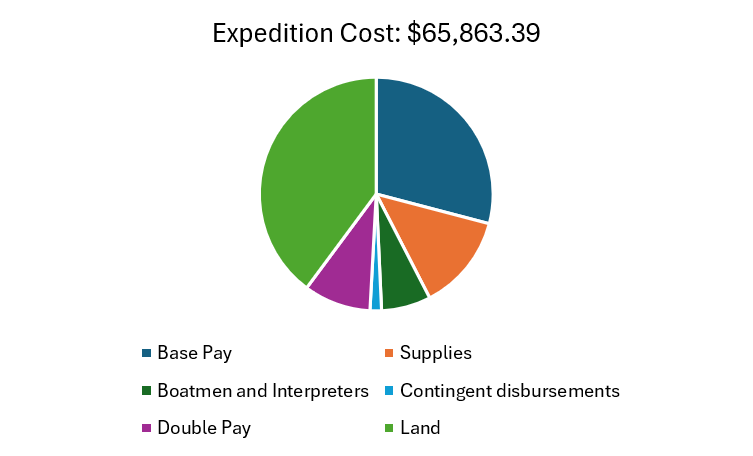
In any case, the dominant category is compensation for the expedition members, at just over 75%. Much of this was due to the bonuses (double pay, land) for a successful expedition.
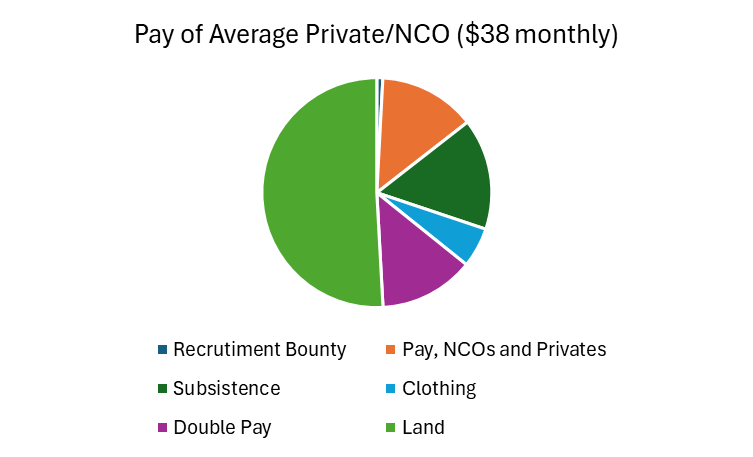
As for what the soldiers themselves were seeing, I split up the amount by type. This is approximate; figuring the exact values is difficult because many members joined at different times, and because some costs are folded in with others. (E.g., “Subsistence of the army, 1806, continued: For this amount being that part of the Rations &c. furnished by the Public & charged to Captain Lewis in this account which he considered as intended for the Soldiers of the party, & which he deducted from them on Settlement—the residue being for the support of Boatmen Interpreters &c. & carried to the expences of the expedition.”)
Here, the dominant reward is land, and the bonuses make up more than half of total compensation. By making an estimate of the number of months the privates/NCOs were paid for at 33 months each (about January 1, 1804 through October 1, 1804), I get a total of $38 monthly. About $13 of this is from base pay and the rest from bonuses.
Finally, we’ve got the civilians to account for. They don’t appear in Lewis’s account (unless they are folded into “boatmen and interpreters”…). But they are compensated in the Act, at a rate of 25/month and 320 acres of land. One source quotes their final dollar compensation as twice those specified in the act, equivalent to 50/month. I’m not sure if that is true and relies on another record of their base pay. But it gets us something like 25 to use as a base rate, which seems reasonable to me.
With all that in mind, I constructed the following base pay table:
Unskilled bearers: 5/month
Soldiers: 15/month
Skilled support (guides, etc.): 25/month or upward (referees discretion)
Expedition Leader: Typically 40/month
All recruitment requires a one-time bonus equal to 3x monthly pay (negotiable).
Expedition leaders are expected to provide food and shelter during the expedition. Members will often expect hazard pay of up to 3x depending on conditions, especially for successful expeditions. Nonmonetary pay, such as land or treasure shares are acceptable if commensurate with salary expectations.
I think the rate for soldiers, skilled support, and expedition leaders are right. I’m not sure about unskilled bearers. Source of the Nile uses the ratio of 5:1, which would put them at 3/month. That is very low. Even 5/month is much less than unskilled laborers. Why would someone go on expedition, with its commensurate risks? I guess the answer is that food and shelter is provided. If they don’t need to pay lifestyle expenses while on expedition, then they are making a profit of 5/month, while your typical unskilled laborer living a poor lifestyle keeps nothing.
That does leave me with questions about what to do with lifestyle expenses. Should I waive them while on expedition? That makes sense to the extent that food and water are part of expedition costs. But, I would like to have a system to account for weapon and armor maintenance and so on even while on expedition. I could break things up based on specifics…like if you have heavy armor, pay a flat cost for that. But that gets fiddly.
I decided to go through something simple. If you live a modest lifestyle or above, you pay half expenses while on expedition. If you live poor or destitute, you pay nothing. This makes the bearer math work and means rogues can live cheap. Heavily armored warriors will still pay maintenance, though.
My analysis did give me a couple of other rules to include. First, there is the idea of signing bonuses. I specified that each individual, when signing on, would expect 3 months salary. That’s a little more than what privates and NCOs got, and seems like a nice way to stop the system from being gamed (i.e., hire people for 10 days, have them fight, then let them go). Then, I included the ideas of bonuses for successful expeditions and the idea of nonmonetary incentives. If the party is clearing a keep to set up a town there, then expedition members can be lured by the idea of their own farm.